The National Institutes of Health (NIH) Deputy Director for Extramural Research, Dr. Sally Rockey, posts in her Rock Talk blog that October grant application submission deadlines will be rescheduled to dates in November. This will allow applicants time to access NIH staff, help desks, and electronic systems. The specific revised due dates will be published in the NIH Guide at a later date. The eRA Commons and other NIH extramural electronic systems are also expected to be accessible to the public on Monday, October 21.
Click here for more information.

Showing posts with label NIH applications. Show all posts
Showing posts with label NIH applications. Show all posts
October 18, 2013

November 05, 2012
Delays in Grant Application Submission due to Hurricane Sandy
From OER Grants: The NIH realizes that the path of Hurricane Sandy may cause problems in grant application submission for organizations located over a wide portion of the east coast. The usual NIH practice for such circumstances will apply. Electronic and paper applications submitted late because of weather problems must include a cover letter noting the reasons for the delay. It is not necessary to get permission in advance for weather-related delays in grant application submissions. The delay should not exceed the time period that an applicant organization/institution is closed.
NIH has established a Web page on the NIH Extramural Response to Natural Disasters that provides information on a variety of topics.
NIH has established a Web page on the NIH Extramural Response to Natural Disasters that provides information on a variety of topics.
October 25, 2012
Your Resubmission—Application Act Two
Nobody likes bad news, but unsuccessful applications are a fact of life every investigator eventually faces.
But unlike the director of a Broadway play, you don't have to worry about your audience walking out on your second act. Your reviewers will play their part, keen on seeing how you addressed their critiques.
Before we discuss the ins and outs of resubmitting, let’s back up to earlier events where you judge whether resubmitting is your most effective tack.
After you learn your application is not fundable, you’ll first need to spend time to effectively deal with your anger and frustration.
When you've done that, you'll be ready to take a cold hard look at your options and do a thorough analysis of your situation so you can determine what to do next.
October 24, 2012
NIH Transparency Helps Offset Austerity
As the National Institutes of Health (NIH) confirms plans to reduce non-competing research grant awards by at least 10 percent as long as the FY 13 continuing resolution is in effect, the agency is pumping out a wide range of resources to build researchers’ capacity to be strong applicants and responsible stewards of federal funding.
The Center for Scientific Review’s Peer Review Notes, published primarily for NIH staff and reviewers, is a rich source of information on review policies and procedures. The September 2012 issue includes fresh perspective on innovation and peer review from Sally Rockey, director of the NIH Office of Extramural Research; advice for new reviewers by former NIH study section chairs; discussion of how reviewers can use the “Additional Comments for Applicants” box to provide thoughtful recommendations to applicants; and insight into who exactly takes part in review meetings.
GRC recommends that researchers and administrators at all experience levels subscribe to Peer Review Notes and to two institute-specific resources that routinely deliver NIH- and even government-wide insight.
October 19, 2012
NIH: Next Steps?
NIH recently created an online resource, Application Guidance: Next Steps, to address frequently asked questions that investigators have about the application review process as well as what the "next steps" are. The questions are grouped into three categories: Scores, Funding Decisions, and Resubmitting. Questions include:
- What does the score mean; will my application be funded?
- When and how will I know if my application will be funded?
- Are all submissions to RFAs new applications?
Further information on the Review Process itself is linked on the Next Steps page and can be found at the Peer Review Process website.
October 02, 2012
From OER Nexus: What’s Next?—Reviewing Your Summary Statement and Thinking About Resubmitting
So you’re wearing your lucky shoes and are ready to take a first look at the results of your grant review. Whether you are anticipating doing a victory dance or getting ready to head out to the nearest kickboxing class, it’s a good time to think about what comes next.
 Some of you have noticed that the summary statements now include a link to a new online resource to address just this question. Especially if you are new to NIH funding, I encourage you to check out this “Next Steps” page, which was put together to help NIH grant applicants with the “What’s next?” questions following receipt of the summary statement.
If you aren't in the position to be preparing Just-in-Time information for an award, but instead are considering resubmission, you may want to consider some of the data that have appeared in my previous blog posts, in addition to the resources available on grants.nih.gov. For example, in the post “Correlation Between Overall Impact Scores and Criterion Scores”, I show how approach, innovation, and significance factor heavily into the overall impact scores. As you look at your summary statement, talk to your NIH program official, and discuss your ideas with colleagues, it might be useful to keep this in mind.
Additionally our podcast series, All About Grants, includes conversations with NIH staff to help you understand how your grant is reviewed, such as these two episodes on summary statement basics and resubmission advice.
Whether you’re new to the grant application process or an experienced applicant, we hope you find these resources useful.
July 03, 2012
Extramural Nexus: What you're missing!
A quick FAQ of sorts is the "You Ask, We Answer" portion. Here is a sample of the questions:
- Is There a Time Limit for Resubmission?
- How Do I Fill Out the Budget Form for an AREA App?
- For a Resubmission, May I Request a Different Study Section or IC?
OER also provides an extensive archive of podcasts specifically designed for investigators by those that know the information best! Topics include:
- Prepare a Successful Grant Application?
- Be an NIH Investigator?
- Understand How Your Grant is Reviewed?
New resources are posted on a regular basis on a variety of new regulations and policies. Examples include:
- Tutorial on new regulations regarding Financial Conflict of Interest (FCOI)
- Sample funded R-21 applications with summaries
- Peer review news and advicee
Dr. Sally Rockey is NIH's Deputy Director for Extramural Research. Her blog "Rock Talk" is updated frequently with new information straight from the NIH.
- Postdoctoral Researchers—Facts, Trends, and Gaps
- What We’ve Learned About Graduate Students
June 01, 2012
From GRC: NIH Launches New Tool for PIs to Evaluate Prospects
The National Institutes of Health (NIH) has recently introduced LikeThis, a new search tool to help principal investigators identify other research projects that have similar goals and objectives as their own. By entering specific search terms or clicking on the “LikeThis” link on their own application or award pages in the Commons, investigators will gain access to awards, publications, and potential partners to help them develop more successful future proposals.
LikeThis is expected to be used in several ways: to identify the likely institute or center to contact as the application progresses and to list as a preference in the cover letter; to formulate new ideas for research based on what NIH has awarded in the past; and to determine whether a research idea really is innovative. The tool is currently available only to principal investigators. Following eRA’s July 19-20, 2012 software release, LikeThis will be made available to signing officials and others with eRA roles such as trainees, postdoctoral researchers, and assistants. In the meantime, see the user guide and frequently-asked questions for more information.
LikeThis is expected to be used in several ways: to identify the likely institute or center to contact as the application progresses and to list as a preference in the cover letter; to formulate new ideas for research based on what NIH has awarded in the past; and to determine whether a research idea really is innovative. The tool is currently available only to principal investigators. Following eRA’s July 19-20, 2012 software release, LikeThis will be made available to signing officials and others with eRA roles such as trainees, postdoctoral researchers, and assistants. In the meantime, see the user guide and frequently-asked questions for more information.
May 01, 2012
From GRC: Inside the Room with an NIH Study Section Member
One of the primary goals of GRC’s Health Research and Education Task Force is to give GRC members an in-depth look into the peer review process at the National Institutes of Health (NIH). To this end, Dave Stone, Associate Vice President for Research at Northern Illinois University and task force co-chair, interviewed Paul Silvia, Associate Professor of Psychology, University of North Carolina at Greensboro, who spoke at GRC’s February conference. Silvia also has served on NIH’s Social Psychology, Personality and Interpersonal Processes Study Section. This interview is a rare window into the NIH review process, and a great resource for GRC members. In the coming months, the Health Task Force plans to interview more NIH reviewers from different study sections.
Silvia’s interview addressed general issues with which all study sections deal, and the following important points were made:
Silvia’s interview addressed general issues with which all study sections deal, and the following important points were made:
- Literature review: Reviewers will be looking for the significance and relevance of the proposed project through the literature cited. Investigators should already know why their research is significant, and include at least two reasons justifying the work by the second paragraph. Investigators should also indicate a clear link to a public health problem;
- Methodology: Despite shorter page limits it is still important to include everything. NIH is very interested in statistical power. And to establish credibility, investigators should always include a timeline. This helps reviewers answer the question of feasibility – can the researcher actually accomplish his/her project goals? Silvia suggested that reviewers are not as concerned about investigators addressing Plan B if the project fails to meet its objectives;
- Personal statement in the biosketch: Silvia recommended applicants pay close attention to this. Investigators should list their research background, their training, and their publication history to make the case for why they are doing this particular project. Reviewers often have a hard time connecting the credentials of the investigator to the proposed research;
- Impact scores: While the impact score involves being judged on five criteria (significance, investigator, innovation, approach and environment) Silvia said the most important of them are significance and approach. Innovation is more appropriate to address in R21 applications where high risk research is valued. Investigator and environment criteria (while important for R15 proposals) are a given in most R01 applications;
- R15 level of effort: Silvia said one course buy-out plus summer effort should be sufficient to establish that the research can be accomplished. He suggested at least 50 percent effort in the summer, plus 10-20 percent effort during the academic year;
- Addressing issues of women, children (NIH considers people 18 to 21 as children) and human subjects in the application: Silvia emphasized this section receives more attention from reviewers than investigators may assume. It is especially important to address research subject sampling. Investigators need to be pro-active in addressing limitations to the subjects available in their regions of the country, and include a collaborator where feasible; and
- Grouped applications: NIH now starts each session with reviews of R01 applications from new and early stage investigators so it may benefit investigators to identify themselves this way. Silvia also said R15 applications receive a huge benefit from being ‘clumped’ because these reviewers are more familiar with the R15 criteria. In closing, Silvia said review committees haven’t seen many R03 (small grant) proposals recently due to their limited funds. R03s are typically used now to leverage funds on an ongoing R01 grant.
April 17, 2012
From GRC GrantWeek: NIH Posts R21 Funded Proposals
The National Institute of Allergy and Infectious Diseases, which leads National Institutes of Health (NIH) efforts to provide proposal-writing resources, has posted four funded R21 proposals and accompanying summary statements online. These recent successful examples reflect the reduced NIH page limit. Each includes a one-page specific aims section, a 12-page research strategy, budget information, and biosketches of key personnel. While the proposals have an allergy/infectious disease research focus, they give researchers in all fields a view into excellent proposal development.
The NIH R21 mechanism supports early-stage project development for new exploratory and developmental research projects. R21 awards tend to support high-risk, high-reward research, with or without significant preliminary data, poised to produce innovations to substantially advance biomedical research. Awards are limited to $200,000 per year, up to $275,000 in direct costs over a project period of up to two years.
The NIH R21 mechanism supports early-stage project development for new exploratory and developmental research projects. R21 awards tend to support high-risk, high-reward research, with or without significant preliminary data, poised to produce innovations to substantially advance biomedical research. Awards are limited to $200,000 per year, up to $275,000 in direct costs over a project period of up to two years.
April 04, 2012
From NIH RockTalk: Does It Matter Where Your Grant Application Is Reviewed?
There are a lot of urban myths out there about NIH grant review. Here is a common one—your chance of getting funded is lower if your application goes to the Center for Scientific Review (CSR) for review rather than to another NIH institute or center (IC). Well, I have the data and took a look.
The first thing to point out is the split between CSR reviews and the other IC reviews is roughly 80/20. In fiscal year 2010, ICs managed the reviews about 17% of all applications. The major difference between CSR and IC reviews are the types of applications they review. While the separation is not absolute, CSR manages the review of most R01, fellowship, and small business applications. ICs manage the review of most program project, training grant, and career development award applications. ICs do review some R01 applications—typically the ones with IC-specific features, as well as specific requests for applications (RFAs). Tip: check the funding opportunity announcement to find out where your application will be reviewed. It is usually stated there. You can also learn where funded grants were reviewed by looking them up in NIH RePORTER, which lists the study section that reviewed them.

So, back to the question, “Does your application have a different chance of success if it is reviewed in CSR or in an IC?” Given the very different mix of applications reviewed, it is perhaps not surprising that the answer is yes, on average. In fiscal year 2010, 17% of all the applications that went to CSR for review were awarded compared to 25% in the ICs.
But that is really comparing apples to oranges. It doesn’t tell you the whole story. A closer look shows that there is essentially no difference in your likelihood of getting funded when you compare the same types of applications. Take R01 applications, in fiscal year 2010, 18% of R01 applications reviewed in the ICs and 19% of applications reviewed in CSR were awarded.
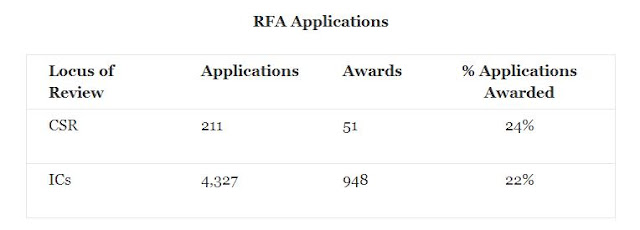
 Another example, applications submitted in response to RFAs in that year were funded at almost identical rates whether reviewed in CSR (24%) or in the ICs (22%).
Since all our reviews comply with the same set of applicable laws, regulations, and policies, I’m glad to see the outcomes are similar, once we compare apples to apples.
The first thing to point out is the split between CSR reviews and the other IC reviews is roughly 80/20. In fiscal year 2010, ICs managed the reviews about 17% of all applications. The major difference between CSR and IC reviews are the types of applications they review. While the separation is not absolute, CSR manages the review of most R01, fellowship, and small business applications. ICs manage the review of most program project, training grant, and career development award applications. ICs do review some R01 applications—typically the ones with IC-specific features, as well as specific requests for applications (RFAs). Tip: check the funding opportunity announcement to find out where your application will be reviewed. It is usually stated there. You can also learn where funded grants were reviewed by looking them up in NIH RePORTER, which lists the study section that reviewed them.

So, back to the question, “Does your application have a different chance of success if it is reviewed in CSR or in an IC?” Given the very different mix of applications reviewed, it is perhaps not surprising that the answer is yes, on average. In fiscal year 2010, 17% of all the applications that went to CSR for review were awarded compared to 25% in the ICs.
But that is really comparing apples to oranges. It doesn’t tell you the whole story. A closer look shows that there is essentially no difference in your likelihood of getting funded when you compare the same types of applications. Take R01 applications, in fiscal year 2010, 18% of R01 applications reviewed in the ICs and 19% of applications reviewed in CSR were awarded.
 Another example, applications submitted in response to RFAs in that year were funded at almost identical rates whether reviewed in CSR (24%) or in the ICs (22%).

Since all our reviews comply with the same set of applicable laws, regulations, and policies, I’m glad to see the outcomes are similar, once we compare apples to apples.
January 04, 2012
From NIH OER: New Changes for the AREA Program
From Sally Rockey, NIH's Deputy Director for Extramural Research:
Last month I told you about our small business programs, and it got me thinking that many people might not be aware of the many NIH programs that exist beyond the scope of the R01. One such program is the Academic Research Enhancement Award (AREA). These awards create hands-on research opportunities for faculty and students at less research-intensive institutions (less than $6M in research and training funds per year). AREA awards provide up to 3 years of renewable funding, with a maximum of $300,000 in direct costs for the entire project period.
As you can see, the popularity of this program has grown over the past several years. We received the highest number of applications to date last fiscal year.

We have been in touch with AREA-eligible institutions who have helped us hone the program. Starting with the latest review round, we now cluster AREA applications during review so that applications from AREA investigators can be reviewed together. This allows reviewers to focus on the specific goals of the program, which are distinct from the other research grants they were reviewed side-by-side with previously (R01s, R21s and R03s).
We’ve also heard your interest in getting AREA-eligible investigators onto review panels. During this past round, we had greater inclusion of AREA-eligible investigators than ever before, in part due to the Center for Scientific Review’s Early Career Reviewer Program. This program specifically targets investigators from less research-intensive institutions.
Finally, for those of you applying to the AREA program, either for the first time or for a renewal, I urge you to read the program announcement. It was recently updated with new language to emphasize and clarify the goals of the program for both applicants and reviewers. Applicants should pay special attention to the sections about including students in the research and demonstrating that you have experience supervising students. I think one of the great benefits of this program is the exposure students get to research, so be sure to highlight that in your application. Reviewers will be evaluating not only the scientific merit of your application, but also how you plan to address the program goals of exposing students to research and strengthening the research environment of your institution.
See the original post on the Extramural Nexus newsletter by clicking here.
Last month I told you about our small business programs, and it got me thinking that many people might not be aware of the many NIH programs that exist beyond the scope of the R01. One such program is the Academic Research Enhancement Award (AREA). These awards create hands-on research opportunities for faculty and students at less research-intensive institutions (less than $6M in research and training funds per year). AREA awards provide up to 3 years of renewable funding, with a maximum of $300,000 in direct costs for the entire project period.
As you can see, the popularity of this program has grown over the past several years. We received the highest number of applications to date last fiscal year.

We’ve also heard your interest in getting AREA-eligible investigators onto review panels. During this past round, we had greater inclusion of AREA-eligible investigators than ever before, in part due to the Center for Scientific Review’s Early Career Reviewer Program. This program specifically targets investigators from less research-intensive institutions.
Finally, for those of you applying to the AREA program, either for the first time or for a renewal, I urge you to read the program announcement. It was recently updated with new language to emphasize and clarify the goals of the program for both applicants and reviewers. Applicants should pay special attention to the sections about including students in the research and demonstrating that you have experience supervising students. I think one of the great benefits of this program is the exposure students get to research, so be sure to highlight that in your application. Reviewers will be evaluating not only the scientific merit of your application, but also how you plan to address the program goals of exposing students to research and strengthening the research environment of your institution.
See the original post on the Extramural Nexus newsletter by clicking here.
May 11, 2011
NIH Personal Statement Template
In January 2010, the National Institutes of Health (NIH) revised their biosketch guidelines to include a mandatory personal statement. The NIH guidelines offer this advice in preparing your personal statement.
“Personal Statement. Briefly describe why your experience and qualifications make you particularly well-suited for your role (e.g., PD/PI, mentor, participating faculty) in the project that is the subject of the application.”
The personal statements we have critiqued as grant writers and the ones that we have evaluated as grant reviewers have been relatively unimpressive. Either they rehash what is in the proposal narrative or read like last minute, uncogitated copy. Relatedly, the NIH guidelines regarding the personal statement are rather terse.
We recommend writing a three-paragraph personal statement with subheadings as follows.
We recommend the personal statement be at least one-half page long. You can find the NIH biosketch guidelines in their updated (March 25, 2011) SF424 R&R instructions here.
Even if you don’t apply for NIH funding, you should look at the NIH biosketch formatting and consider using it in applications to other sponsors, unless they have specific formatting requirements.
“Personal Statement. Briefly describe why your experience and qualifications make you particularly well-suited for your role (e.g., PD/PI, mentor, participating faculty) in the project that is the subject of the application.”
The personal statements we have critiqued as grant writers and the ones that we have evaluated as grant reviewers have been relatively unimpressive. Either they rehash what is in the proposal narrative or read like last minute, uncogitated copy. Relatedly, the NIH guidelines regarding the personal statement are rather terse.
We recommend writing a three-paragraph personal statement with subheadings as follows.
- Proposal Goal. This would be a brief, one-two sentence overview of what the proposal is trying to accomplish in big picture terms. Remind the reviewers what your proposal target is before you persuade them that you can reach that target.
- Relevant Experiences. As you write this paragraph, lift up the different types of experiences you have had, e.g., academic experience, administrative experience, research experience, mentoring experience, research experience.
- Leadership Qualification. In this section, you describe why your relevant experiences qualify you for your role in the project. For example, if you were to be the Principal Investigator (PI) in a project, you might indicate that your prior experiences form a solid foundation to assume the PI role because you have developed administrative skills essential to manage large scale projects that also require a broad range of people skills. You want to point out that you have the ability to manage, decide, and set priorities. Your past experiences have shown that you accept responsibility and carry out action plans. Your communication skills motivate others to accept responsibility and achieve. Use your relevant experiences to show how those developed skills transfer to essential leadership qualifications.
We recommend the personal statement be at least one-half page long. You can find the NIH biosketch guidelines in their updated (March 25, 2011) SF424 R&R instructions here.
Even if you don’t apply for NIH funding, you should look at the NIH biosketch formatting and consider using it in applications to other sponsors, unless they have specific formatting requirements.
April 04, 2011
New NIH Podcasts
Podcast on Writing About Human Subjects in Your Application
Continuing the podcast series on grant writing, the next topic is the human subjects section. Do you need to include this section in your application? Should you include this section if you are using human tissue samples without their personally identifying information? Listen to “Human Subjects Risk and Protection” for answers to these questions and more.
Writing Your Research Plan Podcast
The research plan and other narrative sections of the application are next. Your research project really is a story and can benefit from some careful crafting. Listen to “Telling Your Story” for some tips and advice.
To get new All About Grants podcasts as they are released, subscribe by visiting iTunes or catch NIH's podcast RSS using your favorite software.
October 14, 2010
NIH: New Application Forms for 2011
NIH must periodically implement updated versions of SF424 (R&R) application forms to stay current. Beginning this month, NIH will begin adding a new form package, referred to as ADOBE-FORMS-B1, to all funding opportunity announcements (FOAs).
Applicants submitting for Ks (Individual Research Career Development Awards Programs), Fs (Individual National Research Service Awards), Ts and Ds (Institutional Training and Career Development Programs and Other Training Grants) will be required to use ADOBE-FORMS-B1 for due dates of January 25, 2011 and beyond. Applicants submitting for all other NIH grant programs will be required to use ADOBE-FORMS-B1 beginning May 8, 2011.
As always, we encourage applicants to return to the FOA to pick up the most recent form version before applying. To learn more about the transition and the changes resulting from the forms update (they are minor, for the most part), please read NOT-OD-11-007 and NOT-OD-11-008. To learn about choosing the correct forms package, view the recently updated online resource: "Do I have the right electronic forms for my NIH application?"
Subscribe to:
Posts (Atom)