April 04, 2012

From NIH RockTalk: Does It Matter Where Your Grant Application Is Reviewed?

There are a lot of urban myths out there about NIH grant review. Here is a common one—your chance of getting funded is lower if your application goes to the Center for Scientific Review (CSR) for review rather than to another NIH institute or center (IC). Well, I have the data and took a look.

The first thing to point out is the split between CSR reviews and the other IC reviews is roughly 80/20. In fiscal year 2010, ICs managed the reviews about 17% of all applications. The major difference between CSR and IC reviews are the types of applications they review. While the separation is not absolute, CSR manages the review of most R01, fellowship, and small business applications. ICs manage the review of most program project, training grant, and career development award applications. ICs do review some R01 applications—typically the ones with IC-specific features, as well as specific requests for applications (RFAs). Tip: check the funding opportunity announcement to find out where your application will be reviewed. It is usually stated there. You can also learn where funded grants were reviewed by looking them up in NIH RePORTER, which lists the study section that reviewed them.


So, back to the question, “Does your application have a different chance of success if it is reviewed in CSR or in an IC?” Given the very different mix of applications reviewed, it is perhaps not surprising that the answer is yes, on average. In fiscal year 2010, 17% of all the applications that went to CSR for review were awarded compared to 25% in the ICs.

But that is really comparing apples to oranges. It doesn’t tell you the whole story. A closer look shows that there is essentially no difference in your likelihood of getting funded when you compare the same types of applications. Take R01 applications, in fiscal year 2010, 18% of R01 applications reviewed in the ICs and 19% of applications reviewed in CSR were awarded.

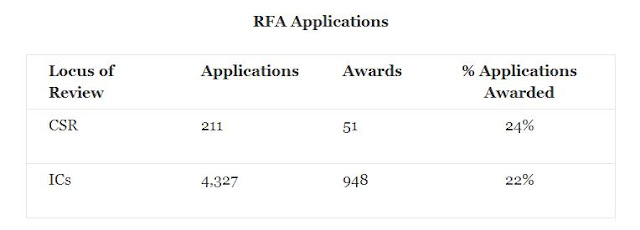
Another example, applications submitted in response to RFAs in that year were funded at almost identical rates whether reviewed in CSR (24%) or in the ICs (22%).

Since all our reviews comply with the same set of applicable laws, regulations, and policies, I’m glad to see the outcomes are similar, once we compare apples to apples.

Fulbright-Hays Group Projects Abroad Program

The Fulbright-Hays Group Projects Abroad Program for 2012 is accepting applications until April 23, 2012. This program provides grants to support overseas projects in training, research, and curriculum development in modern foreign languages and area studies for teachers, students, and faculty engaged in a common endeavor. Projects may include short-term seminars, curriculum development, group research or study, or advanced intensive language programs.

Projects must focus on the humanities, social sciences and languages, and must focus on one or more of the following areas: Africa, East Asia, South Asia, Southeast Asia and the Pacific, the Western Hemisphere (Central and South America, Mexico, and the Caribbean), East Central Europe and Eurasia, and the Near East. Applications that propose projects focused on Canada or Western Europe will not be funded.

The estimated available funds for this program are $2,990,000. The estimated range of awards is $50,000–$125,000 for short-term projects and $50,000–$375,000 for long-term projects.

To read the full program announcement click here.

If you are interested in applying, please contact your department or unit's Proposal Manager in the Sponsored Programs Office.

April 03, 2012

From GRC: Private Giving Not Bigger, but Perhaps Smarter?

Even at their muddiest, the federal budget and agencies’ distribution of discretionary grants are much easier to track than grantmaking in the private sector. Pundits, even foundation leaders themselves, are having a difficult time marking progress toward pre-recession endowment levels.

According to a recent Chronicle of Philanthropy survey, over 70 percent of foundations responding say they plan to give the same amount or less in 2012 than in 2011. The follow-up to 2011’s predictions is also fairly grim. A year ago, 40 of the nation’s largest foundations told the Chronicle they would increase their grantmaking in 2011, but only 25 of those organizations wound up following through. And of 34 grantmakers that predicted their giving would remain flat last year, 10 were forced to decrease.

But beneath the numbers live encouraging trends in creative spending. More foundations are willing to cover operating costs, commit to long-term investments, and reduce red tape to get their funds working faster. Along with the information gathered by the Chronicle, survey results from Grantmakers for Effective Organizations show that foundations are adapting to their leaner financial portfolios with the kind of creativity that makes them more attractive to applicants, not less. J. McCray, chief operating officer for Grantmakers for Effective Organizations, writes in Philanthropy News Digest that foundations ought to “embrace feedback mechanisms to track progress and strengthen relationships with their grantees and community organizations.”

Foundations are much more nimble than federal agencies, allowing them, as in the case of the Durfee Foundation, to act quickly on grantee feedback, and allow applicants to play a powerful role in determining the future of giving. Grantseekers should use this particularly competitive time both to speak up, and to reinforce their use of best practices, such as these strategies offered by the Chronicle: ·

  • Don’t rely too heavily on traditional supporters. Solicit many grantmakers. ·
  • Articulate clearly why the nonprofit’s work matters and be prepared to give concrete examples of its impact. 
  • Stay focused on the charity’s mission. · 
  • Demonstrate how a foundation grant can help secure long-term fiscal health. · 
  • Consider collaborating so that expenses are shared and grant money can go further.

April 02, 2012

From the Institute of Education Sciences: Funding Opportunities Webinars

The Institute of Education Sciences will host a series of funding opportunities webinars in April – August, 2012. These webinars will focus on a wide range of topics for applicants to the FY 2013 grant programs, including the application process, grant writing, and overviews of specific funding opportunities. Full descriptions of the webinars are available and registration is now open.

Register for the webinars by clicking here: http://ies.ed.gov/funding/webinars/index.asp.

Sessions include:
  • General Webinars, including Basic Overview and Application Process
  • Grant Writing Overviews
  • Grant Writing for 84.305A and 84.324A
  • Overviews of Specific Funding Opportunities
Once a webinar has been aired, the presentation slides will be available here

March 29, 2012

2012 Student Symposium Winners

Thank you to everyone who participated and helped out with this year's Student Symposium! It was a wonderful event!

A full recap is in the works, but until then, we wanted to recognize the winners!

Excellence in Content
Daniel Buis, Landscape Architecture
Mentor: Meg Calkins
Title: The Sustainable Theme Park: Designing a net-zero expansion to Holiday World & Splashin' Safari 

Xioadong Zhang, Geological Sciences
Mentor: Jeffry Grigsby and Richard Fluegeman
Title: Sedimentologic change at the Eocene-Oligocene boundary in the Mobil-Mississippi cores

Diana Cordero, Biology
Mentor: Susan McDowell
Title: Effect of Simvastatin on Staphylococcus aureus

Kaitlyn Weiss, Mason Haggerty, & Jacqueline Heath, Physical Education, Sport, and Exercise Science
Mentor: Henry Wang
Title: The effect of seating surface compliance on trunk motion

Excellence in Display
Margaretta Peterson, Landscape Architecture
Mentor: John Motloch
Title: Cultural Design in Landscape Architecture: Creating a Cultural Landscape for the Lakota and Dakota people of Crow Creek Reservation

Eduardo Beltran, Physical Education, Sport, and Exercise Science
Mentor: Henry Wang
Title: The effect of gait retraining on female high school runner with knee pain

March 21, 2012

2012 Student Symposium: Open to the Public!

You are cordially invited to attend: 

Seventeenth Annual Student Symposium 
Tuesday, March 27, 2012
1:30-4:30 p.m.
Second Floor, L.A. Pittenger Student Center

The Ball State University Student Symposium is an opportunity for students to present their creative and scholarly projects in an afternoon poster session. The Symposium also provides a platform for students to learn the ins and outs of creating a poster and to practice speaking professionally with those within and outside their discipline about the work.

Presentations of exceptional merit will be awarded a monetary prize, given in memory of former SPO staff members, Linda Keys, Jeffrey Litten, and Sandra Smith.

Lists of participating departments, faculty members, and students are available on the Sponsored Programs Office website: http://www.bsu.edu/spo.

Thank you, and we hope you can attend on March 27!

March 13, 2012

Dear Colleague Letter: Unsolicited Proposals at the Interface of the Biological, Mathematical and Physical Sciences, and Engineering

From NSF.gov:

Divisions within the Directorate for Mathematical and Physical Sciences (MPS) have seen increasing numbers of proposals in recent years that focus on biological systems at all levels of biological organization, ranging from the sub-cellular level to the environment. Additionally, the Directorate of Engineering (ENG) seeks to contribute to the understanding of biology using engineering tools to exploit unique aspects of biological systems in applications that are useful in industrial, environmental, and health care arenas. At the same time, divisions in the Directorate for Biological Sciences (BIO) are receiving significantly more proposals that incorporate approaches and address questions that have traditionally been the domain of the mathematical and physical sciences and engineering.

BIO, ENG and MPS recognize that it is vital for biological, mathematical, statistical and physical scientists and engineers to increase their collaborations, both in new research efforts and in ongoing research projects, to advance the frontiers of discovery and innovation. While many strong, vibrant interactions currently exist between the three directorates, this letter is to remind our research communities that BIO, MPS and ENG strongly encourage proposals from interdisciplinary research teams that involve collaborations among investigators from the biological, mathematical, and physical sciences and engineering to support new interactions that span interfaces between BIO, ENG, and MPS.

Read the full letter: http://www.nsf.gov/pubs/2012/nsf12057/nsf12057.jsp

March 07, 2012

History in Action: The 15th Annual Student History Conference at Ball State University

On Friday, February 24, 2012, the Ball State University History department hosted its 15th Annual Student History Conference. This year’s speaker, Dr. Jeremy Popkin of the University of Kentucky was invited because of his reputation in the field of French history and particularly because his book, You Are All Free: The Haitian Revolution and the Abolition of Slavery, received the David Pinkney Prize. This prize is awarded annually by the Society for French Historical Studies for the best book on French history published by a North American scholar. His presentation titled “Stories of Saint-Domingue, Stories of Haiti, Stories of the Modern World,” was intriguing on a variety of levels, and relatable to most topics studied by all of the history students.

The conference consisted of various panels, ranging from “Of Cats and ‘Irishmen’: Domesticating Wildness” to “Czarinas, Dictators, and their Challengers.” These panel sessions allowed students to explore the diverse research of Ball State’s History faculty and their fellow undergraduate and graduate students. It was also a great experience for the students who presented. Nancy Lee Clark, a first year graduate student, presented on the origins of the Boy Scouts and how it was primarily a way to take assist young men who were not equipped to deal with the rigors of war. She argued that Robert Baden Powell, a career army man, designed the Boy Scouts to prepare young men to serve in the military and die for God, king and empire. She presented alongside Michael Chudzinski and Timothy C. Rainesalo in the panel “Of Boys and Men: Masculinity, Military Service, and Propaganda in World War One Era Britain.” They indicated that the blending of topics into one, organized discussion was “a great experience – and has made the three of us better prepared” for future professional endeavors.

Dr. Rene Marion, then an Assistant Professor of History in the department organized the first Student History Conference (SHC). The annual Dorothy J. and Richard W. Burkhardt Lecture was moved to the last Friday in February so that it could serve as the keynote lecture in a plenary session of the SHC. Dr. Richard W. Burkhardt specialized in modern European history and Dorothy Burkhardt taught French in the Dept. of Modern Languages. After they retired, their three adult children (including Dr. Richard W. [Chip] Burkhardt, Jr., a Prof. Emeritus of History at the University of Illinois at Urbana-Champaign) endowed an annual lecture in honor of their parents a specifically related to the topic of French history and culture broadly conceived.

Awards 
Eric Spall, BSU M.A. candidate in History, won the award for Best Graduate Paper, entitled, “Leisler’s Rebellion Revisited.”

Joseph Bodley, University of Western Ontario B.A. candidate in History, won the Best Undergraduate World History Paper, entitled “The Noble Radical: Alexander Radishchev and the Culmination of Eighteenth Century Enlightenment thought in Russia.”

Ms. Shira Lurie, University of Western Ontario B.A. candidate in History, won the award for best Undergraduate U.S. paper, entitled “Loading the Dice: Gambling and the Constraint of Chance in Colonial Virginia.”

Photos documenting the 15th annual SHC will be uploaded to the History Department’s Facebook page.

-Blogger Maggie Cude, SPO & Graduate School Graduate Assistant

March 06, 2012

From NIH OER: OMB Asks for Comments on Potential Reforms to Federal Grant Policies

The Office of Management and Budget just published a notice in the Federal Register asking for public comment on potential reforms to federal grant policies contained in OMB circulars such as A-21, A-133, and A-122. These include ideas that would standardize information collection across agencies, adopt a risk-based model for single audits, and provide new administrative approaches for determining and monitoring the allocation of federal funds. These ideas reflect the input of a number of groups that have been considering these issues over the past few months, including the A-21 Task Force, which I have mentioned here before.

I encourage you to read the notice in full. To give you an idea of the scope of the proposed reform, here are some of the ideas discussed:
  • Exploring alternatives to time-and-effort reporting requirements for salaries and wages 
  • Charging directly allocable administrative support as a direct cost Including the cost of certain computing devices as allowable direct cost supplies 
  • Consolidating the cost principles into a single document, with limited variations by type of entity 
  • For indirect (“facilities and administrative”) costs, using flat rates instead of negotiated rates 
As you can see, some of these changes, if implemented, will have a broad, long-lasting effect on how federal grants are administered. Therefore, it is important to take advantage of this opportunity to provide input to OMB as they consider the proposed reforms.

You can submit comments at http://www.regulations.gov. The comment period closes on March 29, 2012.

Read the original post on the Extramural Nexus Rock Talk here.

February 29, 2012

Emerging Media Digital Feed: How Simulation Improves Nursing and Adult Learning

The Emerging Media Digital Feed is a monthly event organized by the center for Emerging Media Initiative (EMI) at Ball State University. The initiative was started for the purpose of advancing Indiana's economy through media-savvy human capital. Each month, EMI organizes an event that features a series of presentations on emerging media topics, their potential, as well as case studies and actual success stories of faculty members or researchers who have integrated those emerging topics into their practice.

This month's event, held on Friday, February 24, 2012 at the Schwartz Complex in Bracken Library, focused on the latest advancements and uses of simulation in nursing and adult education. The event featured two presentations, the first by Dr. Kay Hodson-Carlton, Simulation and Information Technology Center Director, and the second by Dr. Bo Chang, an Emerging Media Faculty Fellow.

Dr. Hodson-Carlton's presentation, titled "Simulation and Information Technology Center: Emerging Technologies for Nursing Education and Practice," focused on the latest developments in simulation in the field of nursing. Most interesting of those developments is the introduction of High Fidelity Simulators for students of nursing. Those accurate simulators, like the Human Patient Simulators for example, offer students the opportunity to experience various life-like situations related to patients and the practice of healthcare. Those patient simulators are programmable and can simulate virtually any scenario that involves nurse-patient interaction. Some of the benefits of the High Fidelity Simulators include higher student satisfaction and confidence, better judgments, and increased quality of health services.

The second presentation, "Integrating the Tool of Simulation into the Teaching of Adult Education," conducted by Dr. Bo Chang, Assistant Professor of Adult and Community Education, focused on her experience in utilizing simulation to improve adult learning. Defining simulation as "imitation of nature," Chang explained how she asked her students to conceptually divide the imitated object (which could be anything, like a plane, a department at a company, a website, or a service) into small parts in order to make it easier to analyze how it functions. Although at first unable to see the actual benefits of simulation, Chang contended, students were at last capable of overcoming their resistance to the new concept and started appreciating learning through simulation over time, especially after they were successful at imitating the objects they studied and saw the actual results for themselves. One group of students, for example, was able to simulate the hiring process of an HR department at a corporation. They first collected data about the recruitment process implemented by a few companies, analyzed the collected data, came up with a model, and then added their own ideas. Chang outlined some of the benefits of simulation for adult learning, which include bridging the gap between theory and practice, time-efficiency, and peer learning.

The next Emerging Media Digital Feed event will be held on Friday, March 30, 2012, at 12:15 PM, and will take place at the Schwartz Complex in Bracken Library. The event will highlight the Center for Media Design’s Insight and Research Unit, in particular the Usability Testing Lab and how faculty can take advantage of related technologies.

More information on the Emerging Media Initiative can be found by clicking here.

-Blogger Abdullah Al-Sheikh Hasan, SPO Graduate Assistant